

Bacteria in the genus Vibrio, such as V. parahaemolyticus, can cause major diseases in aquatic animals, including Acute Hepatopancreatic Necrosis Disease (AHPND), White Feces Syndrome (WFS), Translucent Post-Larvae Disease (TPD), and vibriosis. These diseases result in tens of billions of baht in economic losses to the global aquaculture industry each year. When contaminated food is consumed, these bacteria can also infect humans, causing illnesses ranging from food poisoning to life-threatening septicemia. The improper use of antibiotics to control bacterial infections in aquaculture contributes to the emergence and spread of antimicrobial resistance (AMR), posing a serious threat to both animal and human health.
Vaccines and immunostimulants are promising alternatives to reduce antibiotic dependency. However, currently used inactivated whole-cell vaccines provide protection only against the specific serovar included in the formulation. They do not protect animals against outbreaks caused by other serovars or closely related species. Since pathogenic Vibrio comprise multiple species and strains, developing vaccines that provide broad protection across several pathogenic Vibrio species is essential. Moreover, injectable vaccines are difficult and costly to administer in aquaculture settings, making them impractical—particularly in low- and middle-income countries (LMICs). There is therefore a strong need for low-cost, sustainable, and easy-to-implement vaccine delivery systems.
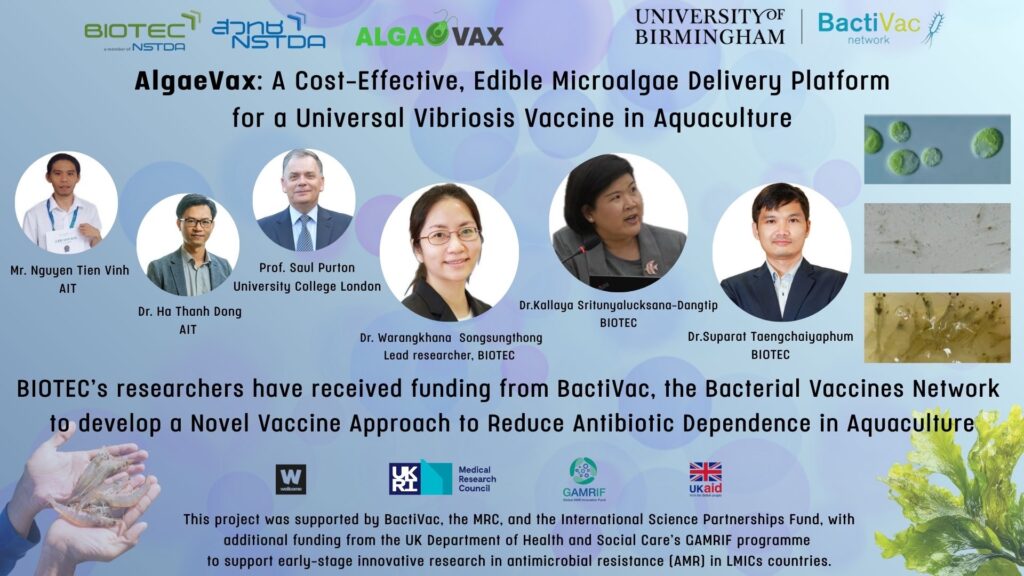
To address this challenge, the “AlgaeVax: A Cost-Effective, Edible Microalgae Delivery Platform for a Universal Vibriosis Vaccine in Aquaculture” project, led by Dr. Warangkhana Songsungthong, in collaboration with Dr. Suparat Taengchaiyaphum and Dr. Kallaya Sritunyalucksana-Dangtip from BIOTEC, NSTDA; Dr. Ha Thanh Dong and Mr. Nguyen Tien Vinh from the Asian Institute of Technology (AIT); and Prof. Saul Purton from University College London (UCL), United Kingdom, has been awarded £70,000.00 (approximately 2,980,000 THB) in research funding from BactiVac, the Bacterial Vaccines Network, administered by the University of Birmingham, United Kingdom. The project period is from November 2025 to July 2026.
The AlgaeVax project aims to develop an edible vaccine that protects aquatic animals against multiple pathogenic Vibrio species using the safe (generally recognized as safe, GRAS), single-celled microalga Chlamydomonas reinhardtii as a platform to produce universal Vibrio antigens. Once the microalgae expressing these antigens—referred to as “AlgaeVax”—are obtained, they can be mixed with pellet feed to create an oral vaccine for aquaculture species. This innovation aims to deliver effective disease prevention at accessible costs, with ease of scaling to industrial levels, while reducing the risk of antimicrobial resistance in aquaculture systems.
This work was funded by BactiVac, the Bacterial Vaccines Network supported by the Medical Research Council (MRC) and the International Science Partnerships Fund. Additional support was provided by The Department of Health and Social Care as part of the Global AMR Innovation Fund (GAMRIF), a UK aid programme that supports early-stage innovative research in underfunded areas of antimicrobial resistance (AMR) research and development for the benefit of those in low- and middle-income countries (LMICs), who bear the greatest burden of AMR.
The views expressed in this publication are those of the author(s) and not necessarily those of the UK Department of Health and Social Care.