

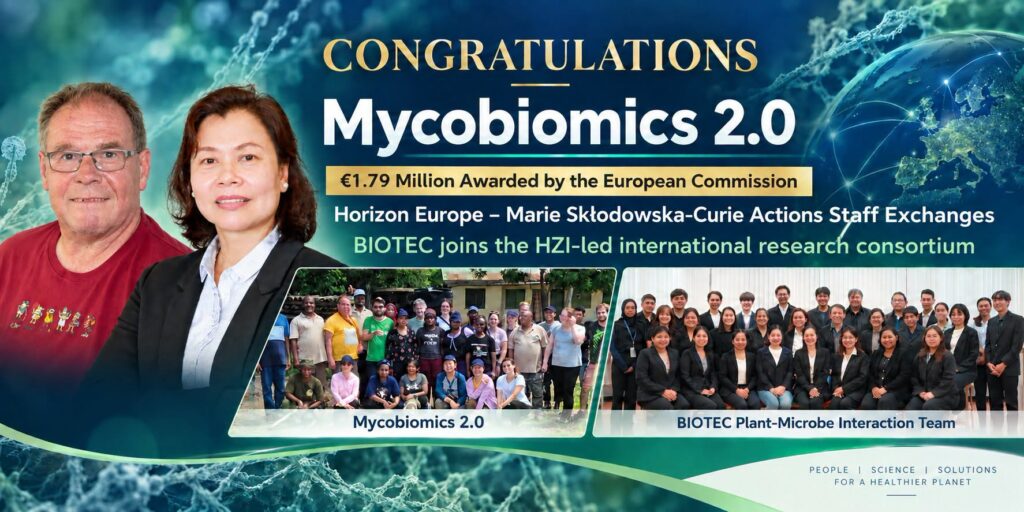
Dr. Jennifer Luangsa-ard, Senior Researcher at the Plant-Microbe Interaction Team, BIOTEC, NSTDA, is participating in the international research project entitled “Joining forces to exploit the mycobiota of the world for beneficial metabolites and potential biocontrol agents, using OMICS techniques (Mycobiomics 2.0).” The project is led by Prof. Marc Stadler of the Helmholtz Centre for Infection Research (HZI), Germany.
The project brings together research institutes and universities from several countries, including the Technical University of Denmark (DTU) and the University of Copenhagen (UCPH), Denmark; the Westerdijk Fungal Biodiversity Institute, the Netherlands; Cranfield University, the United Kingdom; the University of Brest, France; the Institute of Microbiology, the Czech Republic; the University of Pretoria, South Africa; Universidad de Antioquia and Universidad ICESI, Colombia; Egerton University, Kenya; the Federal University of Pernambuco, Brazil; and BIOTEC/NSTDA, Thailand.
Mycobiomics 2.0 has received EUR 1,798,590, or approximately THB 66.55 million, in funding from the European Commission under the Horizon Europe Marie Skłodowska-Curie Actions – Staff Exchanges programme. The 4-year project will run from 1 August 2026 to 31 July 2030.
Mycobiomics 2.0 builds upon and expands the collaborative network established through two previous projects funded by the European Commission: GoMyTri (2014–2018) and MycoBiomics (2020–2025). These projects successfully established an international fungal research network, promoted knowledge exchange, and strengthened the capabilities of researchers and personnel in the field.
Mycobiomics 2.0 aims to advance interdisciplinary research into interactions between fungi and other organisms, with a particular focus on secondary metabolites. Advanced technologies—including genomics, metabolomics, molecular biology, and other omics approaches—will be applied to discover and develop bioactive compounds with the potential to address antimicrobial resistance. The project will also identify promising fungal strains for development into biological control agents against agricultural pests and pathogenic fungi affecting agriculture worldwide.
Through collaborative research, knowledge sharing, and exchanges of researchers and personnel among partner institutions, the project will strengthen the capabilities of Thai researchers and create further opportunities for the sustainable use of biological resources.